Before you start
Learning objectives
After this module you can:
- 1Define the urban heat island (UHI) and explain why it is strongest at night.
- 2Quantify the UHI in Zurich using local measurements.
- 3Explain the role of cold-air flows from Zurich's wooded hills.
- 4Name at least four heat-reduction measures from the city's Fachplanung Hitzeminderung.
1. What is an urban heat island?
An urban heat island is an urban area that is markedly warmer than its rural surroundings. Causes:
- Sealed, dark surfaces (asphalt, concrete, roofs) absorb solar radiation during the day and release it at night.
- Little vegetation and open soil → less cooling through evaporation and shade.
- Dense buildings trap heat and block wind ("urban canyons").
- Waste heat from traffic, air conditioning and industry.
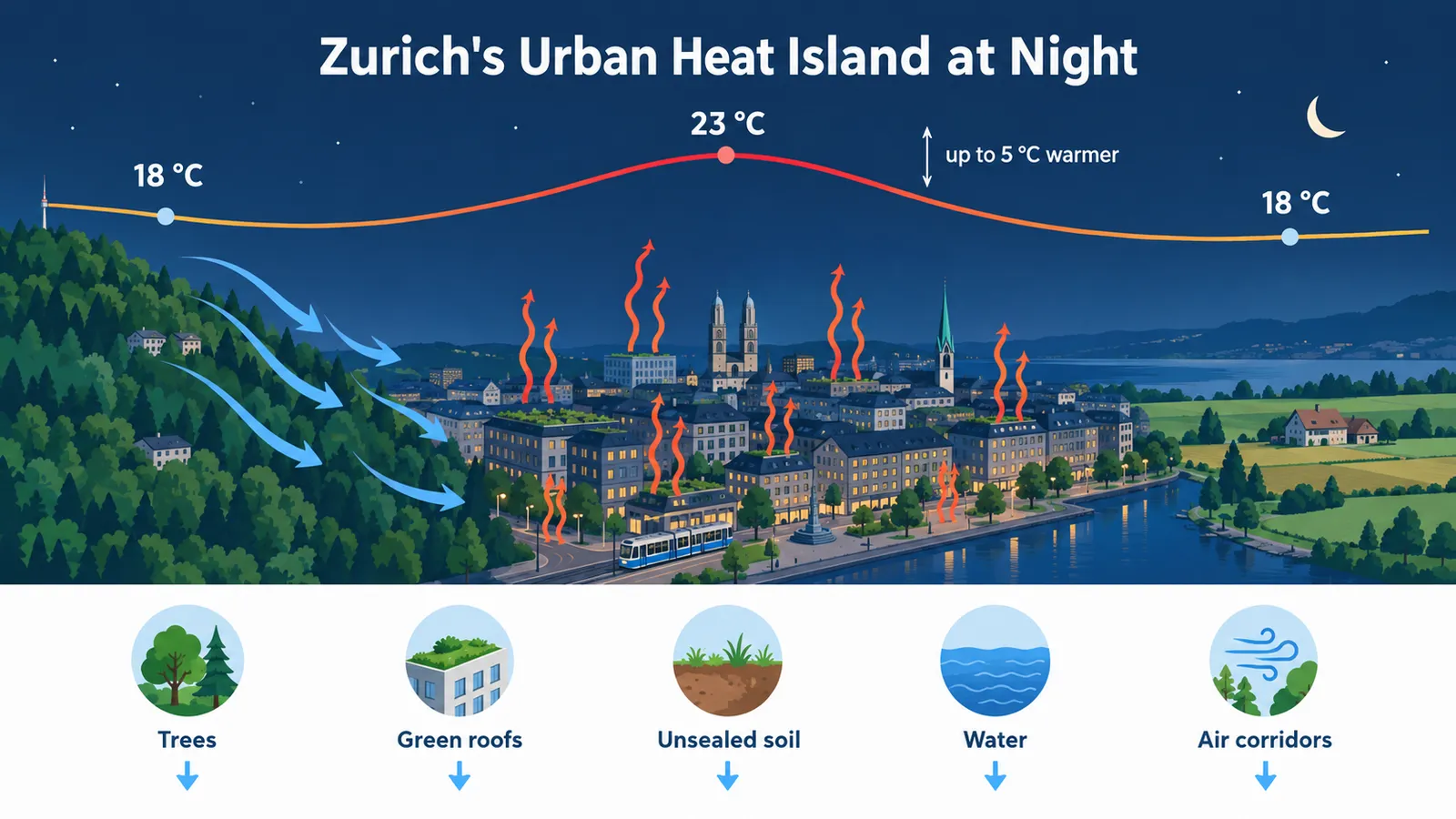
Daytime differences between city and countryside are usually small. The big difference appears at night, when rural areas cool quickly and the city does not. Swiss cities can be up to 5–7 °C warmer at night than their surroundings (MeteoSwiss).
Concept
That is why tropical nights (minimum ≥20 °C) rise much faster in the city than hot days. Without cool nights, the body cannot recover from daytime heat.
2. Zurich's heat island, measured
In summer 2019, Kanton Zürich ran an urban-climate measurement network:
- On tropical nights, central squares were on average 4–5 °C warmer than rural sites.
- Zürich-Affoltern (green, at the city edge) was about 4 °C cooler than the Kaserne and main station (HB).
Tropical nights in summer 2019:
| Site | Tropical nights |
|---|---|
| Paradeplatz | 23 |
| Sechseläutenplatz | 18 |
| Hardplatz | 17 |
| Platform at Zurich HB | 16 |
| Rural sites (e.g., Oberembrach, Elsau) | 0–3 |
Over 1991–2020, the city-centre station Zürich-Kaserne recorded about 8 tropical nights per year, compared with 1 at Fluntern on the hillside. In a 3 °C world, Climate CH2025 projects about 41 per year at Kaserne. The warmest night of the year there would rise from 22.3 °C to 25.6 °C.
Did you know?
The live dashboard stadtklima-zuerich.ch shows minute-by-minute temperatures from more than 100 sensors across the city. Compare your neighbourhood with others on the next hot evening.
3. Zurich's natural air conditioning: cold air from the hills
On clear summer nights, cool air forms over the forested slopes of the Zürichberg, Käferberg and Uetliberg and flows downhill into the city. According to modelling, this cold air reaches about 75% of the built-up area.
Buildings placed across these flow paths can block them. That is why the canton publishes climate maps (Klimakarten) — now at 5 × 5 m resolution — showing heat islands, cold-air flows and a future scenario with +2.5 °C summer warming. Planners use them to keep ventilation corridors open.
4. Cooling the city: the Fachplanung Hitzeminderung
The City of Zurich adopted its heat-reduction plan (Fachplanung Hitzeminderung) in 2020. Its three goals:
- Avoid overheating across the whole city.
- Relieve vulnerable areas — dense neighbourhoods with schools and care homes — with a network of cool, shaded paths and places.
- Protect the cold-air system flowing from the green slopes.
In its first four years, about 40 measures were implemented or started.
The toolbox
| Measure | How it cools |
|---|---|
| Plant and protect trees | Shade + evaporation; a large street tree cools its surroundings by 4–7 °C |
| Unseal surfaces | Open soil stores water and cools by evaporation |
| Green roofs and façades | Lower surface temperatures, retain rainwater |
| Water features & keeping rain on site | Evaporative cooling (sponge city, Module 5) |
| Shade structures | Pergolas, sails, arcades |
| Light, reflective materials | Higher albedo → less absorbed heat |
| Keep air corridors open | Lets cold air flow into the city at night |
The tree challenge
The Fachplanung Stadtbäume aims for at least 25% tree canopy cover by 2050 in the built-up area. Today it is only about 15%, and canopy has been lost, mostly on private land. The least green districts, such as Zürich-West, would need twice as many trees.
5. Why it matters: heat and health
Heat is the natural hazard that kills the most people in Switzerland: 1,402 heat-related deaths in summer 2003, 747 in 2015 and 556 in 2023. In 2024, 85% of heat deaths were people aged 75 or older.
- In Kanton Zürich, climate change caused about 1,700 heat-related deaths between 1969 and 2018 — nearly a third of all heat deaths in that period (Oxford/Bern study, 2025).
- Globally, about 37% of warm-season heat deaths (1991–2018) are attributable to human-caused climate change (Vicedo-Cabrera et al., Nature Climate Change, 2021).
Module 5 looks at how Zurich protects vulnerable people during heatwaves.
Recap
Summary
The urban heat island is strongest at night: Swiss cities are up to 5–7 °C warmer than their surroundings.
In summer 2019, Paradeplatz had 23 tropical nights; rural sites had 0–3.
Cold air from the wooded hills cools about 75% of Zurich's built-up area — if it can flow.
Trees, unsealing, green roofs, water and shade are the main cooling tools; canopy cover is ~15% against a 25% target.
Think it over
Reflect & discuss
Think about these questions or discuss them in class.
- 1Zurich is densifying to limit urban sprawl. How can densification and heat reduction be reconciled?
- 2Who should pay for trees and unsealing on private land — owners, the city, or both?
Test yourself
Quiz
Module quiz · Part 2 of 2
Zurich's Climate and the Hot City
- 5 questions
- Up to 90 points
- Streak bonus +5
- Pass with 70%
You get instant feedback after each answer. This quiz is shared with Module 1 — pass every part to earn the “Climate Detective” badge.
Climate Detective
SourcesReferences (12)
- MeteoSwiss — Hitze in Städten
- Kanton Zürich (2019) — Stadtklima-Messnetz Messbericht
- Kanton Zürich — Klimakarten
- Kanton Zürich (2025) — Aktualisierte Klimakarten
- Stadt Zürich — Fachplanung Hitzeminderung
- Stadt Zürich — Hitzeminderung und Biodiversität
- Stadt Zürich — Fachplanung Stadtbäume
- Stadtklima Zürich live dashboard
- Kanton Zürich — Schwammstadt-Prinzip
- Swiss TPH / NCCS (2025) — Monitoring hitzebedingte Todesfälle
- University of Oxford (2025) — Climate change responsible for 1,700 heat-related deaths in a single European region
- Vicedo-Cabrera et al. (2021), *Nature Climate Change*