Before you start
Learning objectives
After this module you can:
- 1Explain why spruce and beech are losing ground in Kanton Zürich's forests and which species are expected to gain.
- 2Describe phenology and give a measured example of earlier spring in Zurich.
- 3Name two invasive species that benefit from warming in Zurich and their risks.
- 4Explain why a warmer climate can increase frost damage to crops.
1. Forests under stress
About a third of Switzerland and a large share of Kanton Zürich is forest. Many of its trees were planted for a cooler, wetter climate.
Spruce and the bark beetle
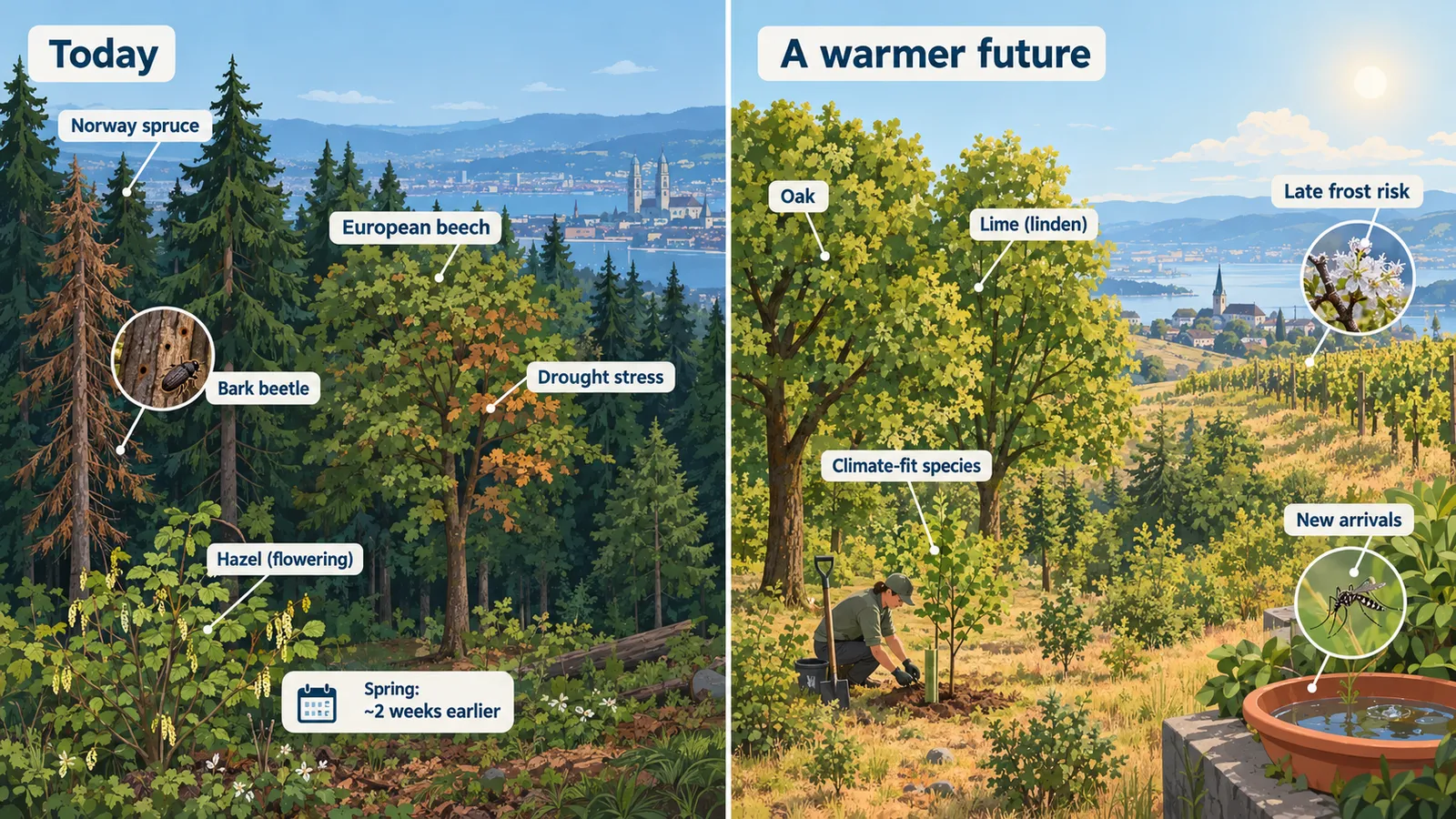
- Norway spruce (Fichte) has shallow roots and suffers in drought. Weakened trees are attacked by the European spruce bark beetle (Buchdrucker, Ips typographus), the most important forest pest in the canton.
- Warmth lets the beetle produce more generations per year. Swiss bark-beetle damage reached a record 2.1 million m³ of wood in 2003 and climbed again to almost 1.5 million m³ in 2019, after the 2018 drought (WSL).
Beech after 2018
The 2018 drought caused many beeches to drop their leaves in mid-summer. WSL researchers followed 963 beech trees, including in the Knonaueramt (Kanton Zürich). Trees that browned early were up to five times more likely to die within three years than green trees (around 4–10% vs 0–2% mortality, depending on region).
Tomorrow's forest
The canton expects spruce and beech to lose importance, while drought-tolerant species such as oak and lime gain. Foresters are already planting mixed, more climate-resilient stands. Because trees live 100+ years, the decisions taken today determine what the forest looks like in 2100.
Concept
Assisted adaptation — humans help ecosystems adapt by choosing species suited to the future climate, not the past one.
2. Biodiversity: species on the move
Moving uphill
As temperatures rise, species shift to higher, cooler places:
- The average elevation of Swiss breeding birds rose by 24 m between the mid-1990s and mid-2010s; for the ten highest-living Alpine species, by 51 m.
- Warm-loving butterflies have increased over 30 years, while cold-adapted species decline.
Species at the top of mountains eventually have nowhere left to go.
Earlier spring (phenology)
Phenology is the study of seasonal events in nature — leaf-out, flowering, bird migration. Kanton Zürich runs 12 phenology stations with records often going back to the 1950s:
- Hazel now flowers almost 2 weeks earlier than in the 1960s.
- In 2026, dandelion at Rafz bloomed 17 days earlier than normal.
- Nationally, the Swiss cherry blossom starts on average 11 days earlier, and some long series show leaf-out up to 30 days earlier than before 1950 (WSL).
Earlier spring can create mismatches: plants flower before their pollinators are active, or birds arrive after the peak of caterpillars they feed their chicks.
New arrivals
Warming makes Zurich habitable for species from warmer regions:
- Asian tiger mosquito (Aedes albopictus): first eggs were found in 2016 near the long-distance bus terminal at Zurich HB. An established population in Wipkingen was reported in 2024, and in 2025 traps were positive in the Industriequartier. It can transmit dengue, chikungunya and Zika — though no infected mosquitoes have been found in Switzerland so far.
- Narrow-leaved ragwort (Schmalblättriges Greiskraut), toxic to livestock, is spreading along roads and railways.
- Allergenic plants benefit too: a longer warm season lengthens the hay-fever season.
Did you know?
The City of Zurich asks residents to empty standing water (plant saucers, buckets) because the tiger mosquito breeds in tiny water containers.
3. Agriculture: drought and the frost paradox
Drought
Most farmland in Kanton Zürich is rain-fed — it depends on rainfall, not irrigation. In 2015 and 2018, farmers lost large shares of their hay and maize harvests, grassland lost one to two cuts, and some dairy farmers had to reduce their herds because they lacked fodder. Emergency irrigation requires a time-limited permit from the municipality, because rivers are already low.
The frost paradox
Warmer winters and early springs cause fruit trees and vines to blossom earlier. But cold-air outbreaks in April still happen. Blossoms are extremely frost-sensitive, so earlier flowering raises the risk of frost damage:
- On 19–20 April 2017, frost destroyed an estimated 80–90% of the expected wine harvest in parts of Zurich, Schaffhausen and Thurgau.
- In April 2021, frost nights caused up to CHF 5 million in damage to apricots, plums, cherries and vines; about 250 insured farms were affected.
Opportunities?
A longer growing season can allow new crops or varieties (for example more heat-tolerant grapes). But these gains are uncertain and come with higher risks from drought, heat, pests and extreme events.
Recap
Summary
Spruce and beech struggle with drought and bark beetles; oak and lime are expected to gain.
Spring is arriving earlier — hazel flowers about two weeks earlier than in the 1960s.
The tiger mosquito has established itself in parts of Zurich.
Earlier blossoming means late frosts hit harder: the frost paradox.
Think it over
Reflect & discuss
Think about these questions or discuss them in class.
- 1Should foresters plant non-native but drought-tolerant species like Douglas fir? What are the trade-offs?
- 2Have you noticed seasonal changes yourself (e.g., early pollen, warmer autumns)? How reliable is personal observation compared with measurements?
Test yourself
Quiz
Module quiz
Nature on the Move
- 9 questions
- Up to 170 points
- Streak bonus +5
- Pass with 70%
You get instant feedback after each answer. Pass to earn the “Forest Ranger” badge.
Forest Ranger
SourcesReferences (9)
- Kanton Zürich — Waldschutz und Waldgesundheit
- WSL / waldwissen.net (2026) — Buchdrucker-Entwicklung in der Schweiz
- WSL / waldwissen.net (Frei et al. 2022) — Laubfall im Sommer als Indiz für späteres Buchensterben
- waldwissen.net (Roth et al. 2021) — Der Einfluss des Klimawandels auf die Biodiversität ist messbar
- Kanton Zürich — Verschiebung der Jahreszeiten
- WSL (2022) — Trees bloom and budbreak earlier and earlier
- Stadt Zürich — Tigermücke
- Kanton Zürich — Folgen des Klimawandels
- plattformj.ch — Frost damage 2017 · 2021